
 Team DailyPedia
A 2011 study by public administration scholars from the University of the Philippines (UP) cited the anti-corruption drive of former President Corazon Aquino as a viable and effective model that could still be adopted by future administrations in the fight against corruption.
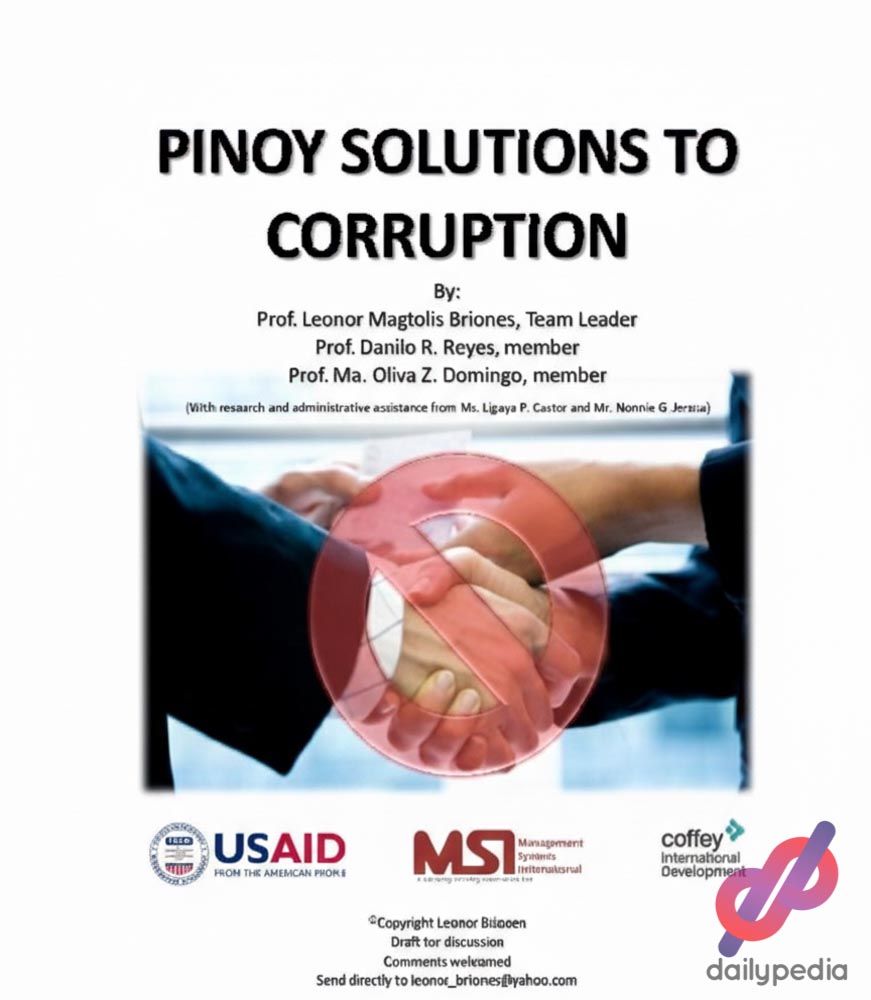
The research, led by Leonor Magtolis Briones, highlighted what it described as the “Cory Model”—an approach that relied on existing government institutions rather than the creation of new agencies or additional public spending. Briones later served as Secretary of the Department of Education under former President Rodrigo Duterte.
Titled “Pinoy Solutions to Corruption,” the study was presented at the UP–National College of Public Administration and Governance, with Briones joined by fellow UP-NCPAG professors Danilo Reyes and Ma. Oliva Domingo as members of the research team.
“During the administration of President Corazon Aquino, significant anti-corruption results were attained without creating a new agency,” Briones said. “She utilized what was already in place without putting up a new organization and without creating new items of expenditures.”
According to the study, Aquino worked within the existing Cabinet structure and government arrangements, demonstrating that meaningful progress against corruption is possible even without institutional expansion.
“It is possible to work within the existing framework of government institutions. Most important, only Filipinos can solve corruption in the Philippines,” Briones said, who also served as lead convenor of Social Watch Philippines.
Briones noted that Aquino’s approach was so straightforward that it “does not even have to be called a strategy.” The only new body created during her presidency was the Presidential Commission on Good Government (PCGG), which was tasked with recovering ill-gotten wealth amassed during the Marcos regime.
Apart from the PCGG, Aquino embedded anti-corruption efforts into the regular operations of the Executive branch. Cabinet secretaries and agency heads were instructed to assess their own offices, develop anti-corruption plans, and submit regular progress reports.
“Since each department and agency was different from the others, the secretaries had different strategies and reported varying results,” Briones explained.
The study stressed that the effectiveness of Aquino’s anti-corruption campaign was largely due to the integrity of her Cabinet members, underscoring the importance of leadership in governance reform.
“The assessment reports on President Cory’s fight against corruption show very clearly that the successes attained were largely due to the integrity of her Cabinet members,” Briones said. “A clear lesson is that the quality of each Cabinet member is crucial in an anti-corruption campaign.”
Researchers concluded that Aquino and her Cabinet left behind a legacy of “fundamental integrity,” which they said should serve as a benchmark for future administrations.
The proposed framework outlined in the study emphasized that any comprehensive anti-corruption campaign must be led by the government, with the President at its center. It recommended coverage across all levels of the Executive branch—national, local, and government-owned and controlled corporations—while encouraging participation from Congress and the judiciary.
Business groups, civil society organizations, academic institutions, faith-based groups, and the media were also identified as essential partners in sustaining anti-corruption efforts.
Briones further observed that conditions at the time of the study closely resembled those during the Aquino administration.
“There is widespread revulsion against corruption. At the same time, there is also widespread trust in the President,” she said. “It can be said that now is the time to launch a massive, comprehensive anti-corruption campaign.”