
 Team DailyPedia
Researchers and professors from Ateneo de Manila University are advocating for an anti-political dynasty law that would prohibit relatives within the second degree of consanguinity from holding elective office at the same time, while still allowing family members to run successively for public posts.
The proposal, outlined in a policy paper released in January 2025, introduces the concept of allowing only “thin dynasties”—political families whose members assume positions one after another—while banning “fat dynasties,” where multiple relatives simultaneously occupy elective offices.
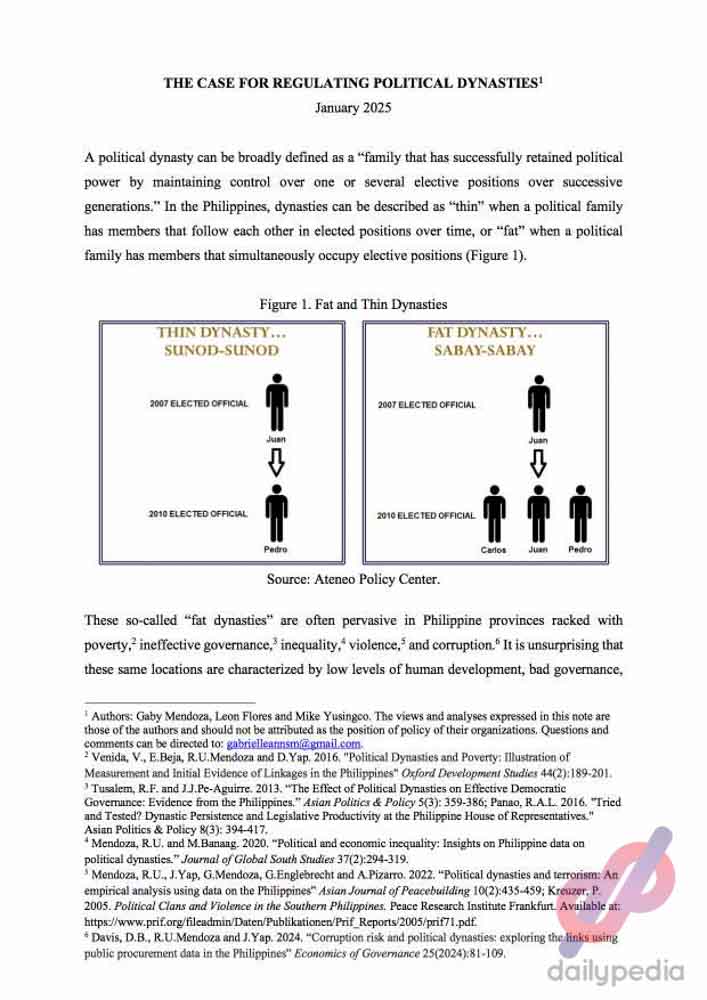
Under the framework cited in the paper, first-degree relatives include parents and children, while second-degree relatives cover siblings, grandparents, and grandchildren.
‘Bawal ang sabay-sabay, puwede ang sunod-sunod’
The authors argue that limiting the ban to relatives within the second degree is the most politically viable and enforceable approach to curbing the concentration of power without undermining voter choice.
“Our proposal for practical political viability of the dynasty regulation law is simple: ‘bawal ang sabay-sabay pero puwede nang payagan ang sunod-sunod.’ Democracy can still thrive when families choose to succeed each other only one at a time,” the paper stated.
According to the study, fat dynasties weaken checks and balances, contribute to poor governance, and are linked to weaker development outcomes. In contrast, regulating dynasties—rather than banning them outright—could help improve policymaking while remaining realistic in the Philippine political context.
The researchers pointed to the Sangguniang Kabataan Reform Act as a working model, noting that it already limits political dynasties up to the second degree of consanguinity.
“The anti-dynasty provision in the Sangguniang Kabataan Reform Act already leads the way in possible reform. This regulates dynasties up to the 2nd degree of consanguinity, allowing many political clans to continue to field their ‘best performing’ and ‘most experienced’ family members,” the paper said.
They added that such a system could weed out “the worst performing and meagerly prepared” candidates, potentially leading to better governance.
Based on their estimates, applying the second-degree restriction across the broader political system could free up at least 25 percent of local elective positions for new leaders.
The authors cautioned against extending restrictions beyond the second degree, citing serious operational challenges.
“Drawing on the existing experience with the SK Law, a restriction up to the 2nd degree may work best, given the operational challenges of tracing linkages up to the 4th degree,” the paper stressed.
They emphasized that any prohibition should apply across local and national elections, including the party-list system, to prevent circumvention.
To ensure effectiveness, the scholars proposed two key provisions for any future anti-dynasty law:
A clear prohibition barring any person from running for national or local office if, upon filing a certificate of candidacy, they are found to be related within the second degree of consanguinity or affinity to another candidate for any elective position.
A designated enforcement agency, with clearly defined powers and procedures to ensure compliance.
“It will help in implementation if many of these processes are triggered upon the filing of certificates of candidacy, in order to clarify dynastic links well before elections,” the paper noted.
At present, both the Senate of the Philippines and the House of Representatives of the Philippines are deliberating on various anti-dynasty proposals, each differing in scope, degree of consanguinity covered, and enforcement mechanisms.